You don't need to have already worked with international clients to land a remote sales job with a US or UK company. Some of the best sales reps haven't worked remotely before or maybe haven't even worked in sales. This guide will break down everything you need to know to get started in remote sales as a South African.
Key takeaways
- SDR and BDR roles don't require prior international experience, but employers do expect a real, provable sales track record.
- Communication and coachability matter, but they don't replace proven results.
- Remote OTE for US and UK companies often runs well above equivalent local roles.
- The tools are simple. You can learn them in a weekend, not a certification course.
- Cold job boards rarely work. A vetted, direct platform does.
Do You Need International Experience to Get a Remote Sales Job?
No, not specifically. What employers are actually looking for isn't a resume proving you've already worked with a US or UK company before. It's proof you can sell: a real track record, quota numbers you can talk through, and the ability to hold a conversation with someone you've never met. Having already worked with an international client is a bonus. It's not a requirement.
Here's some more good news: sales skill is something that is learned, not innate. Something I roll my eyes at is when someone says they don't have sales skills or can't talk to people because they just don't have it. This couldn't be more wrong. A great salesperson is made, not born.
Take it from me. I consider myself naturally introverted, I stuttered in grade school, and I started my career in sales and ended up becoming one of the highest performing reps at my company.
Sales, like any skill, is a muscle you need to work out and practice.
Which Remote Sales Roles Are Easiest to Break Into?
If you're just starting out, two roles are your way in:
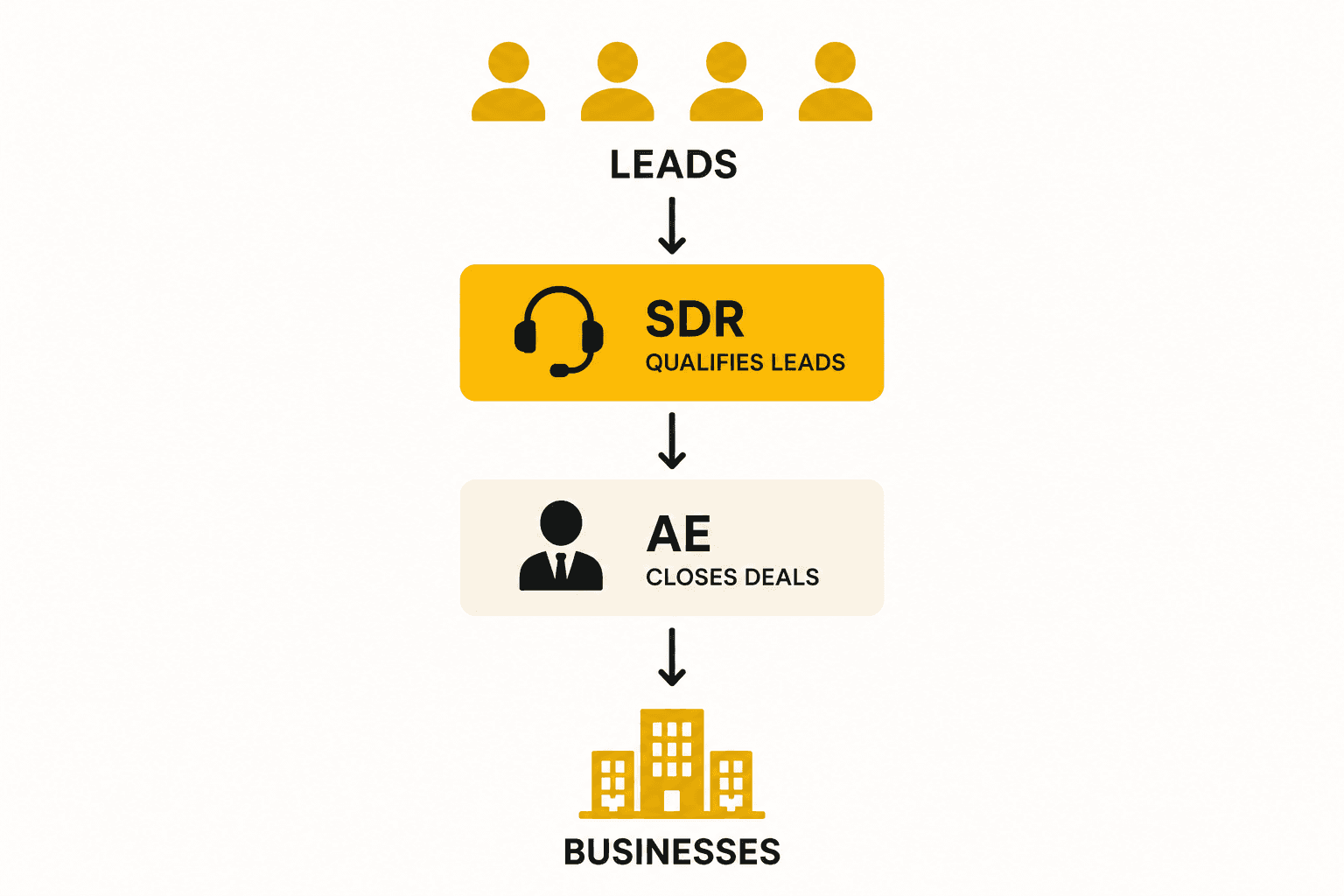
SDR (Sales Development Rep) and BDR (Business Development Rep) both focus on outbound work: finding potential customers, reaching out, and booking meetings for someone else on the team to close. These are the entry points, and they're where almost every remote sales career for a South African candidate starts.
Account Executive (AE) is the next step up. AEs run the actual sales conversations and close the deals. In sales terms, AEs handle inbound sales while SDRs handle outbound sales. Most SDRs move into an AE role within 12 to 18 months, and pay typically increases significantly at that step.
Start with SDR or BDR roles in your search. Don't rule yourself out of a role because you haven't closed deals before. Almost nobody has when they start.
What Do US and UK Companies Actually Look for in a South African Sales Rep?
A few things come up again and again in real job listings for remote SDRs and BDRs:
- Communication skills. Confidence on a call, clear written English, comfort speaking to people you've never met.
- Proactive application. Send a short video to employers on why you'd be a good fit, or put together a short presentation for them. Do something to stand out and your odds of getting hired increase tremendously.
- Coachability. Employers want someone who takes feedback and adjusts fast, not someone who already knows everything.
- A reliable setup. Stable internet and a quiet space to take calls matters more than people expect.
- Basic CRM comfort. You don't need to be an expert, just comfortable navigating one.
- Workable time zone overlap. UK hours line up closely with South African time, which makes UK-based roles an easier starting point for many candidates. US roles are still very achievable, just worth knowing the hours may run later in your day.
None of this requires a global resume. It requires showing up prepared.
How Much Can You Earn as a Remote Sales Rep for a US or UK Company?
A South Africa-based SDR role typically pays an OTE of $1,500 to $3,000 USD per month. The salary usually depends on what you're selling and the company you work for.
A quick note on what OTE means: on-target earnings, meaning base salary plus commission if you hit 100% of quota. It varies by company, and hitting the top of that range isn't guaranteed. When interviewing for a sales role, it's important to ask the company how much revenue and how many deals they're currently doing. You want to avoid companies with no real track record of sales that aren't willing to pay a base salary.
What Skills or Tools Should You Learn Before Applying?
The SDR skillset is twofold: you should learn the soft skills (most important) and then the tools modern SDRs use. Good news, the tools SDRs use are very simple and easy to learn.
The two most important traits of a great sales rep are being able to empathize with their customer and ask the right questions.
You cannot sell to someone if you don't understand their pain points. The first job of a sales rep is to ask good questions so they can understand the customer's pain point.
The second job is to empathize with them so they trust that you understand their problem.
Once you've learned how to do those two things, you're already ahead of the majority of sales reps out there today.
Now let's talk tools:
CRM. Every salesperson needs some kind of CRM. This is the place where they can keep track of their potential buyers and store their contact info. HubSpot and Salesforce are the popular ones, but smaller businesses might even use Google Sheets.
Prospecting tools. A sales rep needs a way to find potential buyers. If they don't already have customers coming in the door (inbound sales), they'll need to go find them elsewhere. Popular prospecting tools include LinkedIn Sales Navigator or ZoomInfo. But depending on the business, it could be good old-fashioned lists online or finding businesses on Google Maps. A trait of a great sales rep is resourcefulness and creativity in finding their prospects.
Sales engagement and outreach tools. A salesperson needs a way to contact their prospects. The most common ways are via email, phone call, text, or social media DMs. For a small business, simple email and phone will work wonders. For mid-sized to enterprise businesses, upgrading to a sales engagement tool to automate and streamline outbound efforts might make more sense.
If you're looking to improve your sales skills, take this free course by HubSpot.
Where Do You Actually Find These Jobs?
If you're looking to find a remote sales job, your best bet is with an international company, most likely based in the US, UK, Canada, or Australia. Over the past few years, demand for South African sales talent has grown fast. UK and US businesses are actively choosing South African reps, not settling for them, and it's spreading well beyond tech into finance, marketing, and sales roles specifically.
To start your search, I recommend using HireSA to browse remote jobs. There's typically a new sales job posted every single day. HireSA is an exclusive talent pool of the best South Africa has to offer, so you won't be competing with hundreds or even thousands of other candidates like you would on other job boards.
Of course, I recommend a two-pronged approach. While you're applying and interviewing through HireSA, use LinkedIn, Pnet, and other services to expand your reach.
How Do You Stand Out Without Prior Remote or International Experience?
The most important thing is to upgrade your work-from-home setup. The only difference between your in-person sales job and a remote sales job is that you're working 100% on your computer in the comfort of your home. While this has many benefits, I recommend you take some time and money to invest in a quality webcam, microphone, and office background.
You might also be working US hours, so being comfortable with the time difference and understanding it may require later hours is necessary.
Having an online presence is also important. This could mean creating a stellar profile on HireSA with a welcome video, and updating your LinkedIn profile. Employers need a way to find you and validate your legitimacy.
FAQ
Do I need a US or UK bank account to get paid?
No. Most companies hiring remote South African talent pay through international payment platforms like Wise, Deel, or Papaya Global, which deposit straight into a South African bank account.
Will my accent be a problem on sales calls?
No. English fluency is a genuine strength South African candidates already have. What matters is clarity and confidence, not where the accent is from.
Is this legal, and do I need to register as a provisional taxpayer with SARS?
Yes, it's legal, and yes, South African tax residents earning foreign income generally need to register as provisional taxpayers. Talk to a tax professional about the foreign income exemption before you start.
How long does it typically take to land a remote sales role?
It varies, but most candidates who apply consistently and prepare well for interviews hear back within a few weeks to a couple of months.
Is this full-time employment or contract work?
Both exist. Some companies hire South African reps as full-time employees through an employer of record, others hire on contract. Read the offer carefully either way.
What if I have local South African sales experience but nothing international on my CV yet?
That's normal, and it's not a disqualifier. Frame your local results in terms international employers understand: quota attainment percentage, deal size, not just job titles.